

Continuing from what was said last time, other aspect of the design for stainless tank:
IV. Design of Insertion Pipes
BPE recommends that the length of insertion pipes extending into the equipment should be as short as possible and that they should be installed above the effective liquid level. There are requirements for the distance between the insertion pipe and the tank wall:
1/2S, 3/4S: distance of 10mm
1S, 1.5S: distance of 15mm
2S: distance of 20mm
Other distances need to be calculated; an excessively large distance may cause foaming.

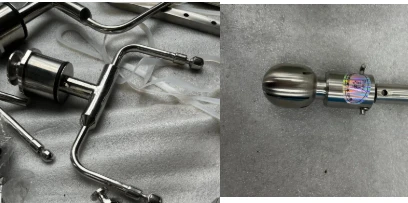
V. Selection of Spray Balls
Spray balls are divided into fixed type and rotary type.
Fixed type: can control the cleaning position, has strong spraying force, and good rebound cleaning effect, but with a large flow rate.
Rotary type: has a small flow rate but poor rebound cleaning effect.
It is better to choose fixed spray balls.
For equipment without mechanical agitation, a fixed spray ball can be installed at the center of the equipment, and insertion pipes and other nozzles can be cleaned by water column rebound.
Unless there are special requirements from customers or the material viscosity is very high (making cleaning by rebound impossible), it is generally not recommended to install two spray balls.
Factors to consider during selection: spray diameter, flow rate, and pressure.
The flow rate should follow the recommendation of BPE. The selection of flow rate should also match the bottom valve; the flow rate should be as small as possible to avoid incomplete draining by the bottom valve. A quick calculation method recommended in the process is: the outlet should be one size larger than the inlet of the spray ball.
VI. Polishing
Currently, the common domestic process adopts wire drawing. The surface finish requirements are: inner surface < 0.4Ra, outer surface < 0.8Ra. Generally, electropolishing is required.
